


Last Updated: October 23, 2026
Quick Summary
Yes, is hypochlorous acid safe for cats when you use a properly formulated topical product as directed. Veterinary guidance describes topical HOCl products as generally non-toxic and safe if a pet licks them, with no known side effects in animals. Never use a household hypochlorous acid cleaner on your cat.
- HOCl is a weak acid that white blood cells release to fight bacteria, viruses, and fungi.
- Check the label for concentration in ppm, pH, intended use, and directions before spraying your cat.
- Bleach is sodium hypochlorite, a strong alkaline solution, and is not interchangeable with HOCl.
- Spray when your cat is calm, let the area air-dry, and use a cone if your vet advises it.
- Call your vet for deep or bleeding wounds, eye involvement, pus, or no improvement after a few days.
Table of Contents
- Is Hypochlorous Acid Safe for Cats? The Short Answer
- What Hypochlorous Acid Is and How It Works
- Why HOCl Is Considered Gentle for Cats
- Hypochlorous Acid Spray for Cats: Reading the Label
- Can Cats Lick Hypochlorous Acid? Licking and Ingestion
- How to Use Hypochlorous Acid for Cat Wounds and Irritated Skin
- Is Hypochlorous Acid Cleaner Safe for Pets and Household Surfaces?
- Side Effects, Sensitivities, and When Home Care Is Not Enough
- Frequently Asked Questions
Is Hypochlorous Acid Safe for Cats? The Short Answer
The question "is hypochlorous acid safe for cats" has a short answer: yes, when you use a properly formulated topical product as directed. A peer-reviewed review of hypochlorous acid describes it as a substance found naturally in all mammals, and it works against a broad range of microbes.
But "safe" comes with conditions. The product has to be made for skin, not for floors. The strength has to be right. And you need to know when a vet should look at the problem instead.
Below, we explain what makes this cleaner different, how to read a label, and how to use it on wounds, paws, and sensitive spots.
What Hypochlorous Acid Is and How It Works
Hypochlorous acid (HOCl) is a weak acid that white blood cells release to fight bacteria, viruses, and fungi. It is part of the body's first line of defense, not a foreign chemical.
The molecule works by breaking down the outer layers of microbes on contact. It also reacts fast and leaves little behind.
Veterinary sources note that topical HOCl products are generally non-toxic and safe if a pet licks them, with no known side effects in animals (VCA Animal Hospitals guidance on HOCl topical products).
Why HOCl Is Considered Gentle for Cats
Cats have thin, sensitive skin and a habit of grooming every inch of it. That combination makes most antiseptics a poor fit. Alcohol stings. Hydrogen peroxide can damage healing tissue. Strong iodine stains and irritates.
HOCl sits in a different category:
- It matches a molecule the body already makes
- It does not sting on contact the way alcohol does
- It needs no rinsing in most topical uses
A common mistake is assuming "gentle" means "no caution needed." Cats still differ from dogs in size and grooming habits. A cat will lick a sprayed paw within seconds, so the product you choose has to be one you are comfortable with her swallowing in small amounts.
Hypochlorous Acid Spray for Cats: Reading the Label
Most cat owners skip the label. That is the single biggest mistake with this product type. Two bottles can carry the same ingredient name and behave very differently on skin.
Concentration, pH, and What the Numbers Mean
Look for three things on the label: strength, pH, and intended use.
- Concentration (ppm): shown as parts per million of free available chlorine. Pet topicals tend to sit in a low, stable range. There is no single number that fits every use, so treat the label's directions as the authority for that product.
- pH: HOCl is only stable in a narrow acidic range. A product that drifts out of it turns into something less effective. A label that lists pH is giving you a quality signal; one that does not is asking you to trust the maker.
- Directions for use: a skin product will say so. A surface disinfectant will list hard, non-porous surfaces instead.
If the label lists no strength and no use directions, treat it as a cleaning product, not a pet product.
A practical label check takes about 30 seconds:
- Find the active ingredient and its concentration.
- Find the intended-use statement (skin, wounds, surfaces, eyes, ears).
- Find the directions for how often to apply and whether rinsing is required.
- Find the caution statement for accidental ingestion or eye contact.
If any of those four items is missing, the product is not giving you enough information to use it confidently on a cat.
HOCl vs. Bleach and Other Chlorine Products
This is the question we hear most: isn't this basically bleach?
No. Bleach is sodium hypochlorite, a strong alkaline solution that burns tissue at skin-contact strength. HOCl is a different molecule with a different pH and a far gentler profile.
The same logic applies to other chlorine-releasing products, such as some pool and spa treatments and industrial sanitizers. Those are formulated for water systems and hard surfaces, not for a cat's skin.
What the Evidence Can and Cannot Tell You
Veterinary guidance and product labels are the strongest evidence you have. Social posts, influencer videos, and marketing pages are not. A product can be genuinely gentle and still be the wrong choice for a particular wound, a particular cat, or a particular body area.
"Safe" is not the same as "appropriate for every situation." A deep puncture, an eye injury, or a wound that is not healing needs a diagnosis, not another spray.
Can Cats Lick Hypochlorous Acid? Licking and Ingestion
Small amounts licked off the coat or paws are generally not a concern with a properly formulated topical product.
The practical issue is different. A cat that grooms right after a spray removes the product before it can do much.
- Spray when your cat is calm and unlikely to groom straight away
- Let the area air-dry for a moment before releasing her
- Use a cone if your vet advises it for a wound she will not leave alone
If your cat swallows a large volume, or shows drooling, vomiting, or lethargy, call your veterinarian. That is true for any product, no matter how gentle.
How to Use Hypochlorous Acid for Cat Wounds and Irritated Skin
Here is the routine we recommend for minor cuts, scrapes, and irritated patches.
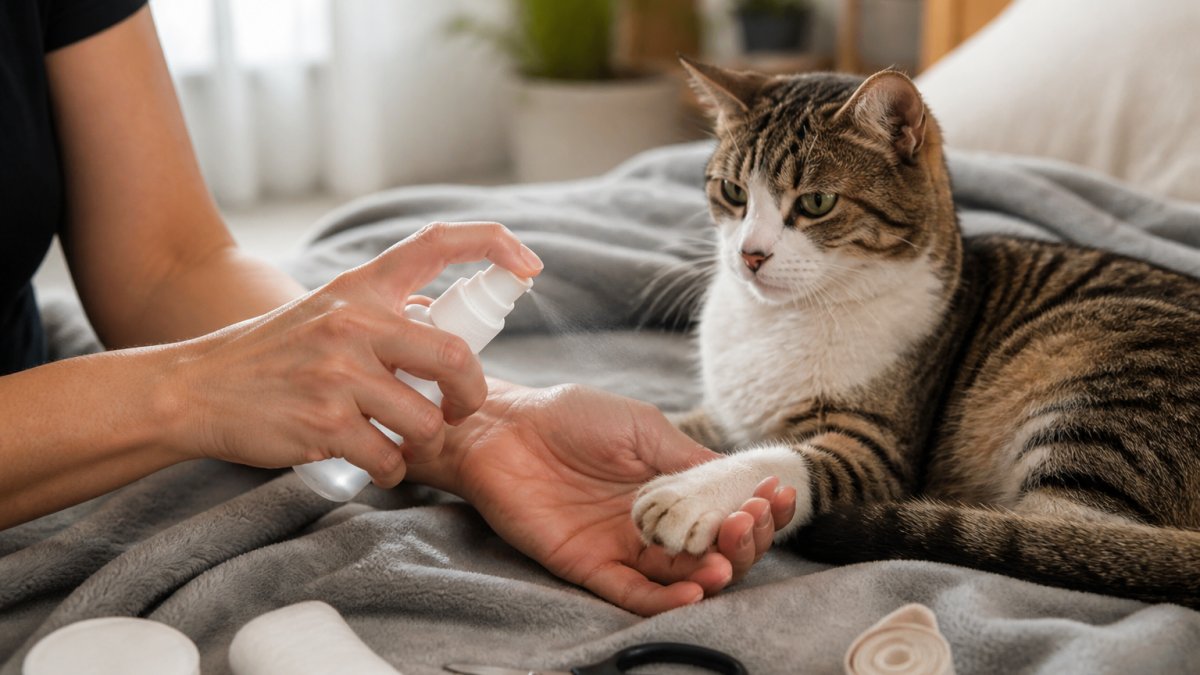
Step-by-Step Application
- Wash your hands and settle your cat on a stable surface.
- Check the wound. If it is deep, bleeding steadily, or smells wrong, stop and call your vet.
- Hold the bottle a short distance away and spray a light mist over the area.
- Let it sit for a few seconds. No rinsing is needed for a topical product.
- Pat dry with a clean cloth if your cat dislikes being wet.
- Repeat as the label directs, usually once or twice a day.
Expected result: the area looks clean and your cat shows no sign of stinging or distress. If she flinches, pulls away, or the skin reddens more, stop using it.
Eyes, Ears, Nose, and Paws: A Closer Look
Sensitive areas need a lighter touch, and not every HOCl product is labeled for them.
Eyes. Never spray directly at an eye.
Ears. Spray onto a pad, not into the ear canal.
Nose and mouth. Keep the mist away from the nostrils and mouth.
Paws. Spray the pads and between the toes after outdoor time, then let her walk it dry.
A useful rule: if the label does not name the area, do not improvise.
When Home Care Is Not Enough
Stop and call your veterinarian if you see any of the following:
- A wound that is deep, punctured, or bleeding heavily
- Pus, a bad smell, or redness that spreads
- Swelling, heat, or pain that gets worse
For daily paw and coat care, our Hypochlorous Pet Spray is made for exactly this. It contains water, salt, and HOCl, nothing else, and costs $7.99.

Is Hypochlorous Acid Cleaner Safe for Pets and Household Surfaces?
A surface cleaner and a pet topical are two different products, and the label tells you which one you hold. A cleaner is made for hard surfaces like counters, crates, and floors. A topical spray is made for skin.
Here is how we would sort it:
| Product type | Use it on | Keep it off | Rinse needed |
|---|---|---|---|
| Pet topical spray | Skin, coat, paws, minor wounds | Eyes, ear canals | No |
| Household surface cleaner | Counters, crates, floors, bowls | Your cat's skin and coat | Yes, on food and water bowls |
| Veterinary-use product | As your vet directs | Anything your vet has not approved | Per vet advice |
If you clean a crate or bowl with a surface product, let it dry fully, and rinse food and water bowls with clean water before refilling. Keep your cat out of the area until it is dry.
Side Effects, Sensitivities, and When Home Care Is Not Enough
Most cats tolerate HOCl well. Still, watch for these signs after the first few uses:
- Increased redness or swelling at the site
- Scratching, rubbing, or biting at the treated area
- Drooling, vomiting, or unusual tiredness
Stop using the product and call your veterinarian if any of these appear.
Home care has limits. A wound that is deep, punctured, or bleeding heavily needs a vet. So does any wound with pus, a bad smell, or spreading redness.
One more thing worth knowing: veterinary researchers still call for more studies on HOCl in cats. The safety picture is good, but it is not finished.
Frequently Asked Questions
Can cats lick hypochlorous acid?
Veterinary guidance on topical hypochlorous acid products says they are generally non-toxic and safe if a pet ingests or licks a small amount, with no known side effects in animals. That applies to properly formulated topical sprays, not to household cleaning products. If your cat licks a treated paw right after you spray, the amount swallowed is tiny. Keep the bottle out of reach, and if your cat drinks a large quantity or shows drooling, vomiting, or lethargy, call your veterinarian.
How often can you use hypochlorous acid spray for cats?
Most topical HOCl products are made for repeat daily use, and the label directions set the schedule. For general paw and coat cleanup after a walk or a park visit, one or two light mists per day is typical. For a minor cut or hot spot, follow your veterinarian's advice on frequency, which may be two to three times daily. Stop and check in with your vet if the area looks worse after a few days of use.
Is hypochlorous acid cleaner safe for pets around the house?
A cleaner and a topical pet spray are not the same product, even when both contain HOCl. Cleaning products may include other ingredients or a higher concentration, so read the label and follow the directions for use, including rinsing or drying surfaces before your cat walks on them. For direct use on skin, coat, or paws, choose a product labeled for animal topical use, such as a veterinary health product, rather than a general surface cleaner.
Can hypochlorous acid be used around a cat's eyes, ears, or mouth?
HOCl is used near sensitive areas, but technique matters. Spray onto a cloth or cotton pad first, then wipe gently outward from the eye or ear, never spraying directly into the eye, ear canal, or mouth. Avoid pooling liquid in the ear canal. For eye issues, eye discharge, or a cat that paws at its ears, see a veterinarian rather than treating at home, since these signs can point to problems a spray will not fix.
Cats get scrapes, hot spots, and grimy paws, and you want something you can reach for without a second thought. e11ement Pet makes a gentle hypochlorous acid spray with three ingredients, made in Canada, for daily skin, coat, and paw care. Start with a patch test, follow the label, and keep your vet in the loop for anything that does not heal. Shop the spray and keep it in your pet-care kit.


