


Last Updated: October 30, 2026
Quick Summary
Hypochlorous acid is lick-safe because it is the same molecule your pet's immune system naturally produces, and our formula contains only water, salt, and HOCl. Lick-safe is a property of the formula, not the molecule alone, so concentration, pH, and ingredients decide whether a spray is safe if your dog or cat licks the treated area.
- Clinical reviews describe HOCl as well tolerated, with no serious adverse effects reported.
- Prolonged use of any HOCl spray can cause irritation, so follow the label's frequency.
- A residue lick of a dried, treated paw is the most common and lowest-risk exposure.
- Cats groom more thoroughly than dogs, so they ingest more residue over a day.
- For a chewed or emptied bottle, call your veterinarian immediately and do not induce vomiting.
Table of Contents
- What Makes Hypochlorous Acid Lick-Safe
- Is Hypochlorous Acid Safe for Dogs?
- Is Hypochlorous Acid Safe for Cats?
- How to Use Hypochlorous Acid Spray on Pets
- Hypochlorous Acid for Pet Paws: Cleaning Up After Walks
- What to Do After Your Pet Licks the Treated Area
- Choosing a Lick-Safe Spray for Your Pet
- Frequently Asked Questions
What Makes Hypochlorous Acid Lick-Safe
Hypochlorous acid is the same molecule your pet's immune system naturally produces. At e11ement Pet, we built our spray around that fact.
The key detail most guides skip: "lick-safe" is not a property of the molecule alone. It is a property of the formula. Concentration, pH, and what else is in the bottle decide whether a spray is safe if your dog or cat licks the treated area.
The Molecule Your Pet's Immune System Already Makes
Hypochlorous acid (HOCl) is a weak acid that white blood cells release to fight microbes. Your pet's body makes it constantly.
That is why it behaves so gently on skin. It is not a foreign chemical. It is part of how mammals handle bacteria every day.
What the Research Says About Tolerability
Clinical reviews describe HOCl as well tolerated, with no serious adverse effects reported. A review of hypochlorous acid literature notes it is nontoxic on surface contact, and a status report on topical hypochlorous acid found topical HOCl appears safe with no major adverse events.
One limit matters: those reviews cover human topical use, not pet ingestion studies. So treat "lick-safe" as a well-supported expectation, not a guarantee that applies to every product.
Is Hypochlorous Acid Safe for Dogs?
Yes. Hypochlorous acid is the active ingredient in our spray. Our formula contains only water, salt, and HOCl.
Watch out: prolonged use of any HOCl spray can cause irritation, so follow the label's frequency rather than spraying more often "to be safe."
Is Hypochlorous Acid Safe for Cats?
Sensitive cats may still dislike the spray sound. Try misting a cloth first, then wiping the area.
How to Use Hypochlorous Acid Spray on Pets
A simple routine:
- Check the label for the recommended frequency
- Part the fur so the spray reaches skin
- Mist the area from a short distance
- Let it air dry
- Wipe away excess on thick-coated pets
For nervous pets, spray your hand or a cloth first and apply by hand. Most pets settle once they learn the spray is not a bath.
Hypochlorous Acid for Pet Paws: Cleaning Up After Walks
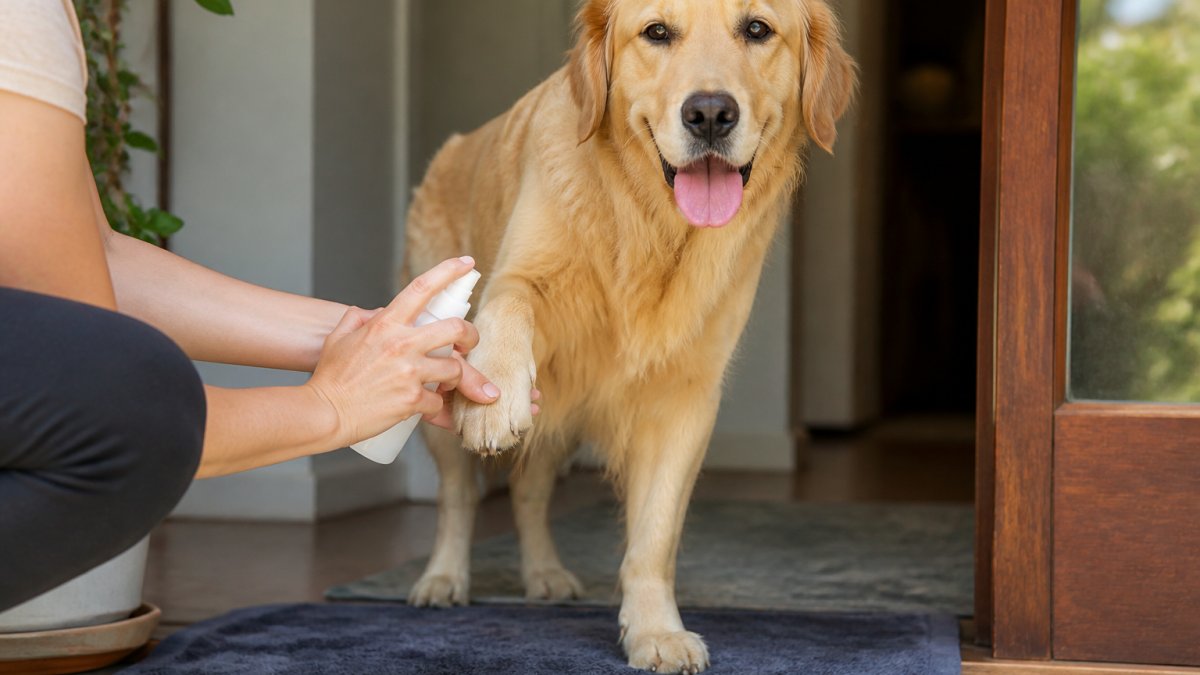
If your dog has cracked pads or visible redness, ask your veterinarian before starting a new routine.
What to Do After Your Pet Licks the Treated Area
If your pet licks a treated area, watch for any changes and contact your veterinarian if you have concerns.
Step 1: Separate a residue lick from a real exposure
These are not the same event, and treating them the same either causes panic or hides a problem.
- Residue lick (most common): your pet grooms a sprayed paw or coat after the product has air-dried. The amount swallowed is tiny, a film on fur, not a mouthful of liquid.
- Wet-product lick: your pet licks the area while the spray is still wet, or licks your hand right after you apply it. Still small, but larger than a dry residue.
- Direct product exposure: your pet chews the bottle, laps from a puddle of spilled product, or drinks from a container. This is the scenario that needs a call, not a wait-and-see.
Step 2: Match the response to the exposure
| What happened | Immediate step | When to call a veterinarian |
|---|---|---|
| Licked a dry, treated paw | Wipe the mouth with a damp cloth if bothered; offer fresh water | Only if signs appear (see below) |
| Licked the area while still wet | Rinse the mouth with water; offer water to drink | If the pet is small (under roughly 5 kg) or a cat or rabbit |
| Chewed or drank from the bottle | Do not induce vomiting; note the amount and the label details | Call right away, especially for cats, rabbits, and small dogs |
A common pattern is that the pet is fine and the owner is more worried than the animal. That is still worth a call if you are unsure, veterinarians would rather answer a calm question than treat a late-presenting problem.
Step 3: Know the warning signs
Watch for:
- Drooling or lip-smacking that does not settle
- Vomiting, especially more than once
- Refusing food or water for more than a few hours
- Lethargy or unusual hiding
- Redness, swelling, or itching at the sprayed site
If any of these appear after a lick, call your veterinarian. Bring the product label or a photo of it, the concentration and ingredient list are the first things they will ask for.
Step 4: Factor in the animal, not just the product
Size and species change the math. A few drops of a dilute HOCl spray is a trivial exposure for a large dog and a proportionally larger one for a kitten, a rabbit, or a small breed. Cats groom far more thoroughly than dogs, so a cat that licks a sprayed paw will ingest more residue over the course of a day. Rabbits and other small pets have less body mass to buffer any ingested amount. None of this makes a properly formulated product dangerous, it means the threshold for "call the vet" is lower for a small animal than a large one.
Choosing a Lick-Safe Spray for Your Pet
Read the label before you trust the word "safe." Read the label before you buy, and use the product only as directed.
What "lick-safe" does and does not mean
- It does mean: the formula is dilute, the ingredients are limited, and incidental exposure through grooming is expected to be well tolerated when used as directed.
- It does not mean: the product is a food, a supplement, or an oral treatment; that drinking it is safe; or that every animal will tolerate it identically.
- It does not override the label: if the directions say external use only, that is the boundary, regardless of how the product is marketed.
Separate a pet topical from a household disinfectant
This is where most confusion happens. The same molecule, hypochlorous acid, appears in pet grooming sprays, human skin products, food-contact sanitizers, and hard-surface cleaners. They are not interchangeable.
| Product type | Typical use | Appropriate for a pet to lick? |
|---|---|---|
| Pet-labeled topical spray | Paw, skin, and coat care | Yes, incidental grooming of a treated area when used as directed |
| Human skin spray | Facial or wound care | Not intended for pets; follow its label, not a pet routine |
| Food-contact sanitizer | Kitchen surfaces | No, rinse and keep pets away until dry |
| Hard-surface cleaner | Floors, bathrooms | No, keep pets off treated surfaces until dry |
A household cleaner may carry a higher concentration, added detergents, or a different pH than a pet topical. Those differences are exactly why "HOCl is safe" is not a blanket statement you can carry from one bottle to another.
The label checks that actually matter
- Intended species and use, does it name dogs, cats, or small pets, and does it say topical?
- Stated concentration, a clear number, not just "gentle" or "professional strength"
- Full ingredient list, ideally limited to water, salt, and HOCl
- No fragrance, alcohol, or added preservatives, these are the usual culprits behind irritation and taste reactions
- Directions for frequency and drying, including whether rinsing is required
- A Canadian regulatory identifier where applicable, for example, a veterinary health product number or a drug identification number, depending on how the product is classified
- Storage and shelf-life guidance, HOCl degrades over time and with light and heat exposure
If a product will not tell you its concentration or full ingredient list, that is the answer. Move on.
Match the product to the job
A spray built for daily paw cleaning between walks is a different product from one meant for a diagnosed skin condition. For routine paw and coat care, a dilute, three-ingredient formula is the practical choice. For an open wound, a hotspot, or a diagnosed skin condition, the product is not the decision, your veterinarian is.
Our hypochlorous pet spray lists exactly three ingredients: water, salt, and HOCl, and is made in Canada at $7.99.

For a quick reference, here is how the routine breaks down:
| Situation | What to Do | How Often |
|---|---|---|
| After a walk | Spray paws, air dry | Daily |
| Coat touch-up | Mist and let dry | 2-3 times weekly |
| Pet licks treated paw | Wipe mouth, offer water | As needed |
| Large spill ingested | Call your vet | Immediately |
Frequently Asked Questions
Can hypochlorous acid irritate sensitive skin?
Formulation and concentration matter more than the ingredient name alone. Start with one application a day on a small area, watch for visible redness or scratching, and stop if your pet reacts. Pets with broken skin, hot spots, or a known skin condition should be checked by a veterinarian before you add any spray to their routine.
Is hypochlorous acid safe if a dog licks it?
Check the label for a pet-specific formula and keep the bottle out of reach so a dog cannot drink from it.
Can cats lick hypochlorous acid spray?
Cats groom constantly, so any spray you apply to their coat or paws will end up in their mouth. If your cat has a skin condition or you are unsure about the formula, ask your veterinarian first.
What should I do if my pet swallows a large amount of hypochlorous acid spray?
Contact your veterinarian or an animal poison service right away if your pet swallows a large amount or if you are unsure how much was consumed. Store the bottle in a closed cabinet so accidental access is not possible.
Most pet owners want a simple hygiene routine that will not irritate sensitive skin or trigger a reaction. That is exactly what we built e11ement Pet for: one gentle molecule, three ingredients, and a formula made for daily use on skin, coat, and paws. Get started with e11ement Pet and give your pet a spray you can both stop worrying about.


